Lars Carter · 3 October 2026
Tracing the Impact of Tessellation Techniques on Resource Efficiency in Virtual Environment Construction Pipelines
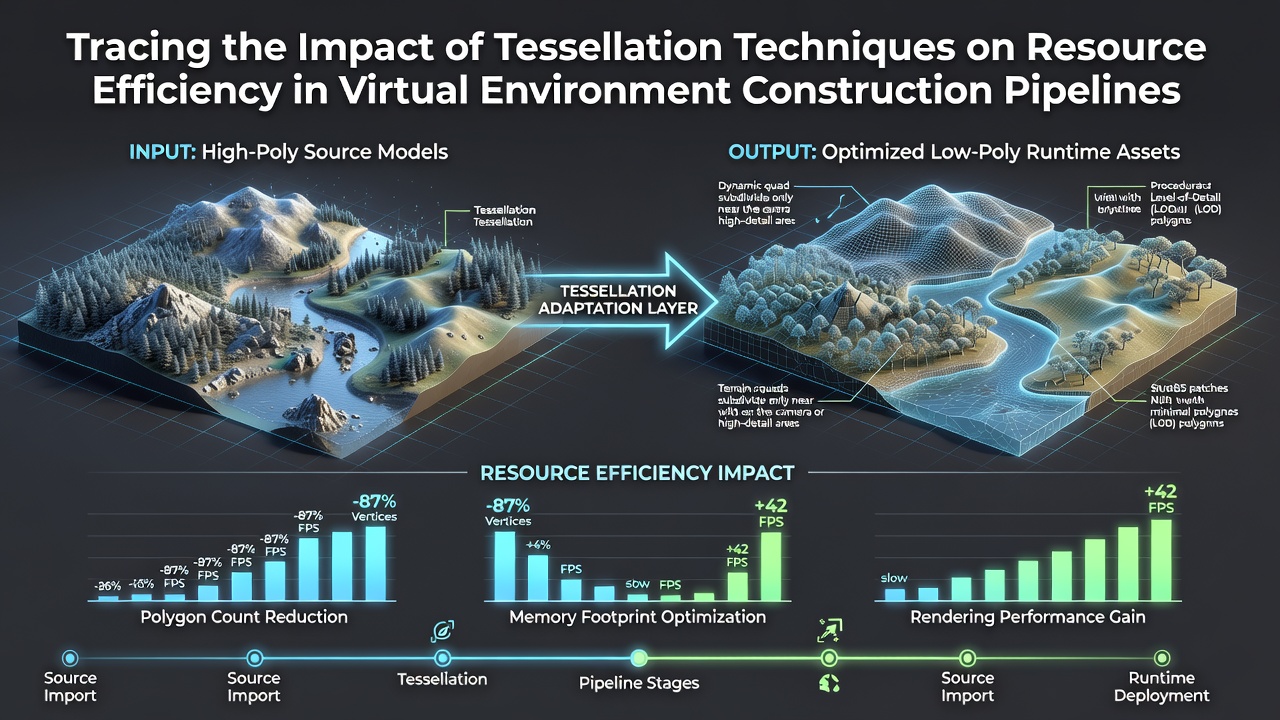
Tessellation techniques subdivide polygonal meshes into finer geometry during rendering, and researchers have tracked their effects on resource consumption across virtual environment pipelines since the introduction of hardware tessellation units in the late 2000s. Data from multiple graphics studies show that adaptive tessellation reduces overall vertex counts by limiting subdivision to visible or high-detail areas, whereas uniform approaches increase memory bandwidth demands without proportional visual gains.
Core Mechanisms in Pipeline Integration
Graphics APIs such as DirectX 11 and Vulkan expose tessellation stages that operate between vertex and geometry processing, and engineers integrate these stages into construction pipelines by defining hull and domain shaders that control patch density. Studies indicate that displacement mapping combined with tessellation lowers texture memory usage in large-scale environments because surface details shift from bitmap storage to procedural geometry generation, yet the same studies note that cache thrashing occurs when patch sizes exceed typical GPU thread group limits. Observers note that pipeline builders often calibrate tessellation factors based on screen-space metrics, which allows systems to maintain frame rates while scaling geometry complexity across different hardware configurations.
Resource Metrics Across Development Stages
Construction pipelines for virtual environments track CPU preprocessing time, GPU memory allocation, and draw call overhead, and tessellation influences each category differently. Research indicates that pre-tessellated meshes raise initial asset sizes by 30 to 50 percent in many reported cases, while runtime tessellation shifts the load to the GPU and reduces storage requirements on disk and during network transmission. Figures from industry reports reveal that bandwidth savings appear most clearly in streaming scenarios where only coarse base meshes travel to client devices and subdivision happens locally, although this pattern reverses when high-frequency displacement data must accompany the base mesh.
Comparative Performance in Production Environments
Teams building large open-world simulations report that selective tessellation applied only to terrain and character surfaces cuts peak VRAM usage by amounts that vary with view distance settings. One study released by a European research consortium compared fixed-function tessellation against compute-shader alternatives and found that the latter improved thread occupancy on certain architectures while maintaining similar geometric output. And data collected during stress tests show that over-tessellation quickly saturates shared memory buses, leading developers to implement distance-based falloff curves that cap subdivision levels beyond a certain threshold.

Developments Anticipated by October 2026
Industry observers expect hardware vendors to introduce refined tessellation units that support variable rate shading integration by October 2026, and early specifications suggest these units will further decouple geometric density from pixel shading costs. Academic papers presented at recent conferences already outline methods that combine machine-learning predictors with tessellation factors to anticipate viewer movement and pre-compute patch densities, which could reduce runtime evaluation overhead in interactive pipelines. International standards bodies continue to refine extensions that allow finer control over tessellation patch ordering, an adjustment that addresses current bottlenecks in multi-threaded asset loading.
Case Examples from Implemented Systems
Engineers working on simulation platforms for training applications adopted hardware tessellation after benchmarking showed that memory traffic dropped when base meshes stayed under 100k triangles and subdivision occurred on demand. Another project involving architectural visualization pipelines replaced static LOD hierarchies with dynamic tessellation and recorded lower CPU-side vertex buffer updates, although GPU utilization rose during camera transitions until shader constants were optimized. Those who studied these deployments note that success depended on tight coupling between culling routines and tessellation factor calculations so that off-screen patches never received unnecessary subdivision work.
Conclusion
Resource efficiency gains from tessellation techniques remain measurable when pipelines apply subdivision adaptively and account for hardware-specific limits on patch size and memory bandwidth. Continued refinement of API extensions and predictor models points toward further reductions in both storage and compute demands as virtual environment construction scales to larger datasets.